

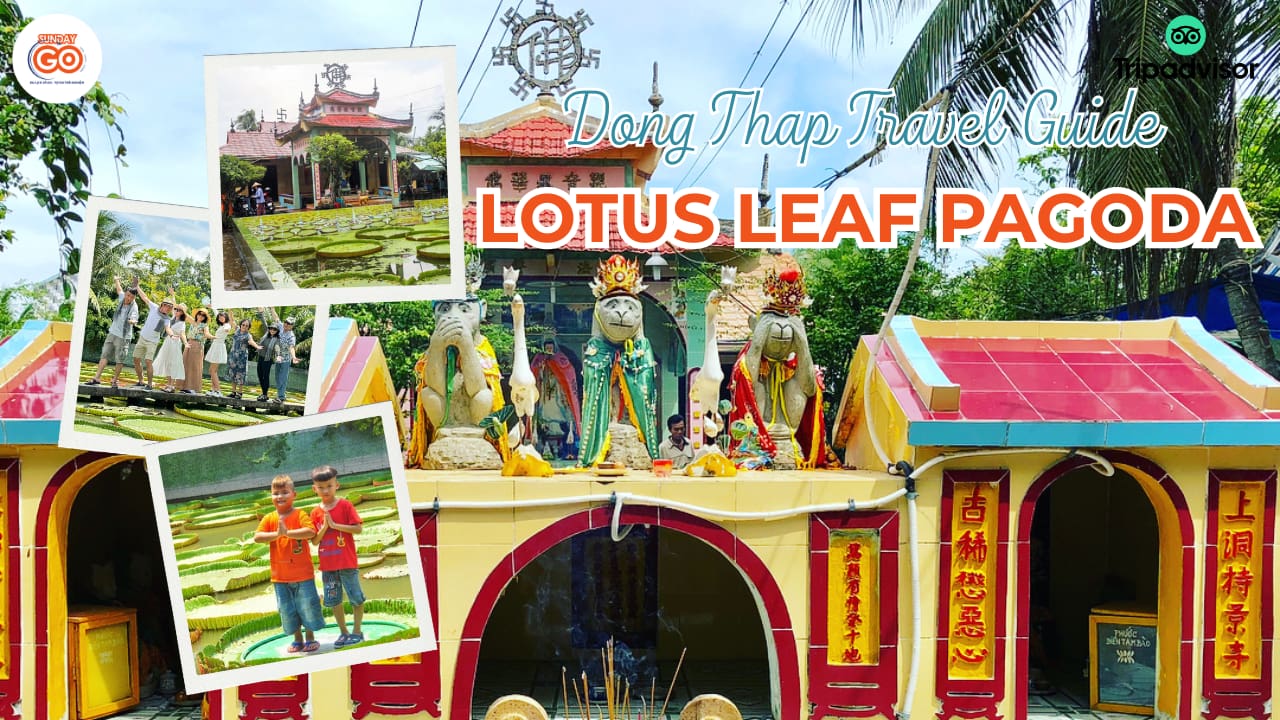
Have you ever imagined standing on a floating lotus leaf like a character in a fantasy movie? In the heart of Vietnam’s Mekong Delta, this isn’t a myth—it is a reality.
Welcome to Phuoc Kien Pagoda (known locally as Chua La Sen), a hidden spiritual gem in Dong Thap Province. Unlike the famous Phuc Kien Assembly Hall in Hoi An, which attracts tourists for its architecture, this small temple in the south draws adventurers for a natural wonder: giant lotus leaves capable of supporting the weight of a human adult.
For international travelers looking for unique, “off-the-beaten-path” experiences, this is a must-visit destination. At Sunday Go, we specialize in making these remote, magical locations accessible. Whether you need a private car or a customized Mekong Delta tour, we are here to guide you to the giant leaves.
The Legend of the Lotus Leaf Pagoda (Chua La Sen)
When you enter the temple grounds, the first thing you notice is the tranquility of the ponds. But look closer, and you will see the star attraction: the King Lotus.
The Science Behind the Magic
The lotus species here is scientifically known as Victoria amazonica. Originating from the Amazon basin in South America, these plants found a unique home in the shallow, silt-rich waters of the temple’s ponds.
The leaves are thick, rubbery, and incredibly strong. They feature high edges that make them look like giant green tea trays floating on the water.
- Size: In the peak season, the leaves can expand to 3 meters in diameter.
- Strength: A mature leaf can support a person weighing up to 70kg – 80kg (approx. 154 – 176 lbs).
The Experience: Standing on Water
Is it safe? Yes, but with a specific technique. To ensure your safety and protect the leaf from tearing, the monks or local attendants place a thin tin basin or wooden board on the center of the leaf. This distributes your weight evenly. Standing on the leaf offers a surreal sensation—a slight wobble, a connection with nature, and the perfect photo opportunity to show your friends back home.
Phuoc Kien Pagoda History: Resilience Through War
While the giant lotus leaves steal the spotlight, the history of Phuoc Kien Pagoda is equally compelling. It demonstrates the deep trustworthiness of the site as a place of genuine heritage, not just a tourist trap.
Founded in the 18th century (before the reign of King Thieu Tri), the pagoda has served as a revolutionary base during Vietnam’s wars of resistance. The temple you see today is actually a reconstruction.
- The 1966 Bombing: Tragically, the original structure was almost entirely destroyed by bombs in 1966, leaving only the entrance gate intact. The local community and monks rebuilt it with simple materials, prioritizing spiritual function over grandeur.
The Legend of the Crane and the Turtle
Inside the temple, ask your guide about the “Crane and Turtle.” Legend has it that a crane flew to the temple and perched on the back of a resident turtle. They became inseparable friends. When the turtle died, it was embalmed and is now preserved in a glass case at the temple, symbolizing longevity and friendship—a touching story that adds emotional depth to your visit.
Best Time to Visit for “Giant” Leaves
This is the most critical part of planning your trip. The size of the lotus leaves changes with the seasons of the Mekong Delta.
- Floating Water Season (September – October): This is the best time to visit. As the water levels rise in the Mekong Delta, the lotus leaves drink up the nutrients and expand to their maximum size (up to 3 meters). They are thick, lush, and extremely strong.
- Dry Season (March – July): The leaves shrink significantly, often to just 1 meter in width. While still beautiful, they may be too brittle to stand on during these months.
Visitor Guide: Location, Tickets, and Etiquette
Navigating rural Vietnam can be tricky. Here is the essential logistical information to ensure a smooth trip.
Location
- Address: Hoa Tan Commune, Chau Thanh District, Dong Thap Province.
- Distance: Approximately 150km from Ho Chi Minh City and 30km from Sa Dec city center.
Entrance Fees & Costs
- Entry Ticket: Free. This is a place of worship, and the monks do not charge admission.
- Lotus Leaf Photo: If you wish to stand on the leaf, there is usually a small service fee (roughly 20,000 – 30,000 VND) paid to the locals who manage the bridge and help you onto the leaf safely. This money often goes toward maintaining the wooden bridges and feeding the temple animals.
Etiquette
- Dress Code: Please dress modestly. Cover your shoulders and knees (no tank tops or short shorts), as this is a functioning religious site.
- Silence: Maintain a quiet volume to respect the monks and prayers.
How to Get to Phuoc Kien Pagoda from Ho Chi Minh City
The pagoda is located deep in a rural district, accessed by narrow village roads. Large 45-seat tourist buses cannot reach the entrance.
Option 1: The Adventurous Motorbike Route
You can ride a motorbike from Saigon along National Highway 1A to the My Thuan Bridge, then turn onto Highway 80 towards Sa Dec. This is scenic but exhausting (3-4 hours one way) and risky for inexperienced riders.
Option 2: Public Bus + Taxi
Take a bus from Mien Tay Bus Station (HCMC) to Sa Dec. From there, you must hire a “Xe Om” (motorbike taxi) or a local taxi to navigate the small roads to Chau Thanh.
Option 3: The Sunday Go Solution (Recommended)
For international tourists, the most comfortable and time-efficient method is a private car rental or a guided tour.
- Comfort: AC car to escape the tropical heat.
- Access: Our drivers know the exact drop-off point where you can switch to a smaller local vehicle to reach the gate.
- Support: We handle the language barrier with the locals for your leaf-standing experience.
Nearby Attractions: Make it a Day Trip
Since the pagoda is quite far from the city, we recommend combining it with other famous Dong Thap attractions for a full day of culture.
- Sa Dec Flower Village: One of the largest flower capitals in Vietnam, famous for growing flowers on raised bamboo trellises above water.
- Huynh Thuy Le Ancient House: The stunning architectural setting of the famous novel/movie “The Lover” by Marguerite Duras.
- Kien An Cung Pagoda: An architectural masterpiece nearby with intricate Chinese designs.
FAQ: Common Questions About Phuoc Kien Pagoda
Q: Is the giant lotus leaf real or plastic?
A: It is 100% real organic vegetation. It is the Victoria amazonica species.
Q: Can children stand on the leaves?
A: Yes, children are light enough and safe to stand on them. It is a fantastic memory for families.
Q: Do I need a visa to visit this area?
A: You need a valid Vietnam visa to enter the country. Sunday Go provides fast and reliable visa services if you haven’t arranged this yet.
Conclusion
Phuoc Kien Pagoda is more than just a photo opportunity; it is a testament to the wonders of nature and the resilience of the Vietnamese spirit. Standing on a giant lotus leaf in the middle of a peaceful pond is a memory that stays with you long after you leave the Mekong Delta.
