

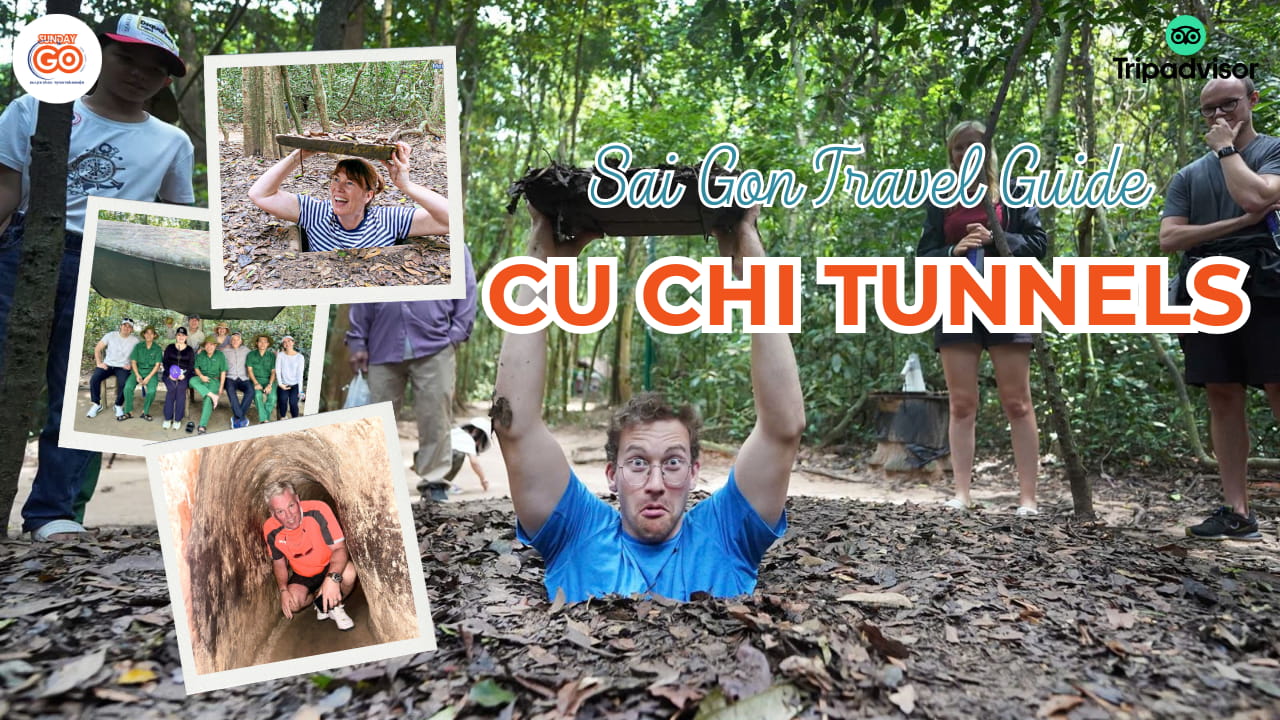
Cu Chi tunnels in Saigon Vietnam
The Cu Chi Tunnels are a large underground tunnel system near Ho Chi Minh City (Saigon) that shows how local people lived, moved, and survived during wartime. This guide explains the history in plain English and helps you plan a smooth visit—tickets, transport, what to do, and which tunnel site to choose.
Quick facts for travelers
Where are the Cu Chi Tunnels? The main tourism site (Khu Di Tich Lich Su Dia Dao Cu Chi) is in Phu Hiep Hamlet, Phu My Hung Commune, Cu Chi District, about 55 km northwest of central Ho Chi Minh City. The Ben Dinh area is on Provincial Road 15.
How long does it take to get there? The trip is commonly around 2.5 hours each way by road, and public buses can take up to about 3.5 hours.
Opening hours: The site is open until 5:00 PM, and many visitors prefer going in the morning for a more comfortable pace.
Ticket price (entry fee): Entrance tickets are listed as 35,000 VND/person for Vietnamese visitors and 70,000 VND/person for foreign visitors (prices may vary between Ben Duoc and Ben Dinh).
Two main tunnel sites you’ll hear about: Tourists currently visit the tunnels mainly at Ben Duoc and Ben Dinh.
What the Cu Chi Tunnels are (and why they matter)
The Cu Chi Tunnels are often described as a symbol of Vietnam’s resilience and creative wartime engineering. The tunnel system started forming during the Indochina War (1946–1954), with initial construction beginning in 1948, and it later grew into a connected network across multiple villages.
During 1961–1965, described as an intense period of the Vietnam War, the northern communes of Cu Chi built a main “backbone” tunnel line and added branch tunnels linking hamlets and communes. Above ground, the area also functioned as a guerrilla battlefield, with fighting positions, trenches, minefields, and camouflaged booby traps.
By 1965, the tunnel network reached about 200 km in total length, and after reunification about 120 km are preserved by the Vietnamese government (with only a portion used for tourism). Inside the system, there were spaces for living, meetings, first aid, storage, and other daily wartime needs—not just hidden passageways.
Inside the tunnel system (what you’ll actually see)
The Cu Chi tunnels were built with three depth levels: about 3 meters, 6 meters, and roughly 9–12 meters underground. The design included concealed access hatches, air vents for circulation, and in some areas underground wells for water.
One famous feature is the “Hoang Cam” stove—an underground kitchen setup designed to vent smoke in a way that reduced detection risk. The passages were originally very tight (about 1–1.2 m high and 0.6–0.8 m wide), sized for smaller bodies and difficult for larger outsiders to enter.
For visitors today, some tunnel sections have been expanded to make them more accessible than they were in the past. A practical reference from the on-site guidance is that even people around 183 cm (6 ft) can access the tourist tunnel sections, though they may need to crouch.
Plan your visit (weather, transport, tips)
Best time to visit (weather)
Cu Chi, as a district of Ho Chi Minh City, follows a similar hot and humid pattern with two seasons: rainy season from May to October and dry season from November to April. Many visitors prefer the dry season because the tunnels are drier and less humid, while the average temperature inside is around 28°C (82°F).
In the rainy season, the entrances are in covered underground sections so the tunnels generally don’t have water leaking in, but the air can feel damp and the walls may be wet to the touch. If you want fewer crowds and softer heat, go early in the day and return by midday, which is also a common visiting pattern mentioned for comfort.
How to get to Cu Chi Tunnels from Ho Chi Minh City
A common route is by road using QL22 or TL15, which lead to Cu Chi. For international travelers, a guided tour with an English-speaking guide is often recommended for convenience and context, and the road journey is typically around 2.5 hours.
If you want to go independently by public transport, buses 4, 122, and 70 are mentioned as options, though they may require multiple transfers and take longer. Private options like taxi/ride-hailing are also used for comfort, and the article notes services like Grab and Xanh SM as available choices.
Ben Duoc vs Ben Dinh (which should you choose?)
Both Ben Duoc and Ben Dinh are active visitor areas for the tunnels. Ben Dinh is described as being on the TL15 route and about 12 km to the southeast from a reference point in Cu Chi district context.
If you want a quieter and more “memorial + history” feel, many travelers pair the Ben Duoc area with the nearby Ben Duoc Memorial Temple visit. If you want an easier logistics choice (especially on a tight schedule), Ben Dinh is commonly used on classic half-day group tours because it’s straightforward to access.
What to wear and bring (simple checklist)
Because crawling through tunnels is a main activity, the guide recommends lightweight, breathable clothes and avoiding many layers. While shorts and sandals can work, long pants and sturdy shoes with ankle support are suggested for better protection, and insect repellent is highly recommended (especially in rainy season).
Try to leave big backpacks outside before entering tunnel sections, because space is limited and movement is harder when you carry things. If you’re sensitive to tight spaces, start with the shortest tunnel option first and decide how you feel before doing longer sections.
Safety and comfort (what most people worry about)
Visitors usually begin with a short presentation and documentary-style introduction before going into the jungle trail and tunnel area. For tunnel crawling, the tourist route described includes a first tunnel section of about 20 meters with an exit at 10 meters, and another section of about 70 meters with an exit as well.
That “multiple exits” structure is one reason many visitors who feel nervous can still try it, because you’re not forced to finish the full crawl. If you’re on a guided tour, staying directly behind the guide is suggested as it can feel calmer than being stuck between people if someone stops suddenly.
What to do at Cu Chi Tunnels (top experiences)
Crawl through the tunnels (the main highlight)
After the introduction, you’ll walk forest trails where guides may show camouflaged hatches and explain how they were used. When it’s time to crawl, you’ll usually be asked to leave your backpack behind to move more easily.
Start with the shortest section first, then decide if you want to continue to the longer section. Remember: today’s visitor tunnels are expanded compared to wartime dimensions, but they still feel narrow, warm, and close.
See wartime artifacts above ground
Along the trail, visitors can see displayed remnants of heavy military equipment and shells, used to illustrate the impact of war. Guides also demonstrate hidden entrances and camouflage techniques that helped protect the tunnel network.
Visit Ben Duoc Memorial Temple (if you want a deeper emotional stop)
Ben Duoc Memorial Temple (Den Tuong Niem Ben Duoc) is described as a significant historical site near the tunnels, built to honor those who died during resistance wars in the Saigon–Gia Dinh–Cho Lon region. The memorial complex was constructed from 1993 to 1995 and covers about 7 hectares, with structures such as the Tam Quan Gate, the House of Inscription, and the Main Temple.
The Main Temple includes inscriptions of over 45,000 names on granite plaques, and visitors can also go up the Nine-Story Tower for wide views. A 16-meter stone obelisk stands at the rear and is described as a mourning symbol for fallen martyrs.
Try the Cu Chi Tunnels shooting range (optional, 18+)
A nearby shooting range offers real firearms such as AK-47, M-16, and other models listed, with supervision by on-site professionals. Visitors must purchase at least five rounds, and the price is stated as about 40,000 to 60,000 VND per round depending on the firearm, with targets around 30 meters away.
The rules described include being over 18 and not being under alcohol or stimulants, and earmuffs are provided (optional but recommended). If you’re not comfortable with guns, you can simply skip this and spend more time on the history sections—many visitors do.
Play paintball (more about teamwork than history)
Paintball is presented as a team activity with masks, uniforms, body armor, and replica-style paintball guns (M-16 or AK-47 style). Pricing is described as about 3,000 VND per round, plus a service fee of 50,000 VND per hour for equipment, with magazine sizes varying by weapon type.
Do the treetop adventure park + zipline (if you want something active)
A treetop adventure park is described as opening in 2022, with 15 challenges over a total length of 350 meters. It also includes an 80-meter zipline and an 8-meter “Tarzan jump,” and the installation is described as supervised by the Ben Duoc Tunnel board of management.
Join the “Warzone Moon” night tour (a different way to learn history)
A night tour themed “Warzone Moon” is described as starting in March 2024 and running from 6 PM to 9 PM, with a stated capacity of up to 60 visitors per tour and a listed price of 399,000 VND per person. The program is described as including effects like light and smoke for a model battlefield, a 3D animated movie recreating Operation Cedar Falls (1967), and a live performance showing village life activities such as tunnel digging and rice milling.
If you’ve already done the daytime tunnels, the night tour can feel like a “story + atmosphere” experience rather than just a walk-through. Because capacity is limited, it’s smart to confirm availability early if you really want it.
What to eat at Cu Chi (simple, local, meaningful)
A classic snack at the site is steamed cassava roots served with peanut salt and sugar, described as a simple food with wartime meaning because cassava was a key ration ingredient for soldiers. Another local dish mentioned is beef spring rolls (Bo Cu Chi Cuon Banh Trang), and the Ben Duoc Restaurant is suggested for a fuller meal after exploring.
Souvenirs with purpose
Souvenir shops are described as selling handmade items created by local communities, including people affected by war-related hardship, and buying these items is presented as a way to support livelihoods. Common items mentioned include hats, bandanas, statuettes, and small models made from ammunition cartridges.
Quick FAQ
Q: How much are Cu Chi tunnels tickets?
A: The listed entry fee is 70,000 VND for foreign visitors and 35,000 VND for Vietnamese visitors, with a note that prices may vary slightly by site.
Q: Is it okay if I’m tall or bigger-bodied?
A: The visitor tunnels are expanded, and guidance states even visitors around 183 cm (6 ft) can enter, though crouching is needed.
Q: Can I do Cu Chi tunnels in the afternoon?
A: The site is open until 5:00 PM, but many people still choose morning for a more comfortable pace.
Conclusion
The Cu Chi Tunnels are not just a “thing to tick off” near Saigon—they’re a place where history feels close, physical, and human. If you go with the right expectations (heat, tight spaces, emotional stories) and choose the tour style that fits you, your Cu Chi tunnel tour can become one of the most memorable days in Vietnam.
