

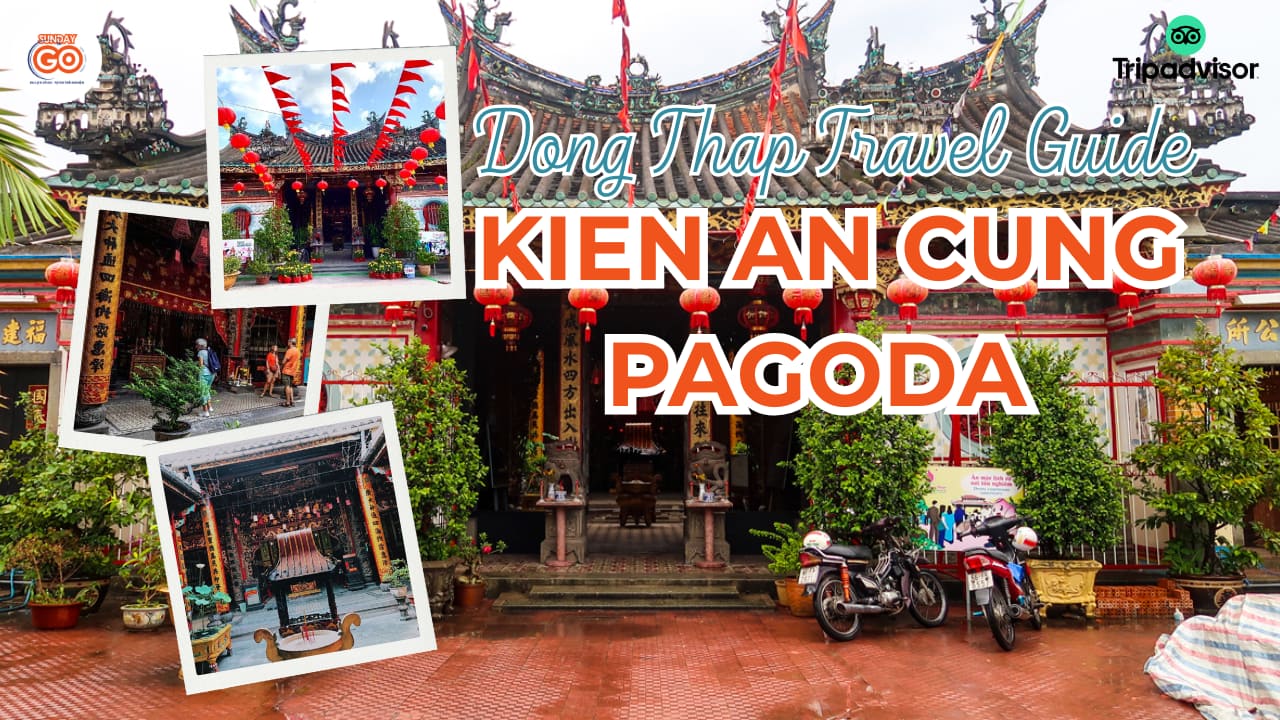
Kien An Cung Pagoda – Sa Dec, Dong Thap
When people think of the Mekong Delta, they often picture floating markets and endless rice paddies. But hidden in the heart of Sa Dec City lies an architectural masterpiece that transports you back to the early 20th century: the Kien An Cung Pagoda.
For travelers exploring Dong Thap Province, this isn’t just another temple. It is a vibrant, living museum of art and spirituality. With over 5 years of experience crafting journeys through Vietnam, the team at Sunday Go considers this one of the most photogenic and culturally significant stops in the region.
Here is everything you need to know about visiting this “National Historical Relic,” from its unique roof tiles to the best time to visit.
A Gift from the Fujian Community (History)
To understand Kien An Cung, you have to look back to the 1920s. Sa Dec was a bustling trading hub, and many Chinese immigrants from Fujian (Phuc Kien) settled here to do business.
The pagoda was constructed between 1924 and 1927 by this community, led by the prominent merchant Huynh Thuan. It wasn’t built solely for worship; it served as a “Hui Guan” (Assembly Hall)—a community center where merchants could meet, trade, and support one another in a new land.
Despite the turbulent history of the 20th century, the pagoda has survived remarkably well. In 1990, it was officially recognized as a National Historical Relic by the Ministry of Culture, Sports and Tourism, cementing its status as a must-visit heritage site.
Architecture Decoded: The “Gong” Shape
What makes Kien An Cung different from other temples in Vietnam? It is the masterful application of Chinese architectural principles.
The entire structure is built in the shape of the Chinese character “Gong” (工). This layout is not just symbolic; it is a brilliant piece of ancient engineering. The design creates open courtyards (skylights) between the front and main halls, allowing natural light and cool breezes to flow through—essential for the tropical heat of the Mekong Delta.
The “Wave-Like” Roof
The most striking feature is the roof. It is crafted with Yin-Yang tiles laid in a wave-like pattern that mimics the movement of a dragon. The roof ridges are incredibly ornate, featuring miniature palaces and complex statues.
The “Chien Nien” Technique
Look closely at the dragons and phoenixes on the roof. They are made using a traditional technique called Chien Nien (cut porcelain). Artisans take broken ceramic bowls and plates, cut them into precise shapes, and paste them together to create vibrant, weather-resistant mosaics.
The Wooden Pillars
Inside, you will notice there are no rafters holding up the roof. Instead, the structure relies on large, round wooden pillars. These beams are intricately carved with gold-gilded designs depicting ancient legends, birds, and flowers.
Who is “Ong Quach”?
You might hear locals refer to Kien An Cung as Ong Quach Pagoda. This often confuses international tourists who are looking for the official name.
The reason is simple: The main deity worshipped here is Guangze Zunwang (Quang Trach Ton Vuong), often affectionately called Ong Quach by the Vietnamese.
Unlike many other Chinese temples that worship Guan Yu (the God of War), Ong Quach is a deity associated with filial piety and protection. On the 22nd day of the 2nd and 8th lunar months, the pagoda hosts major festivals to honor him. If your trip aligns with these dates, you are in for a treat of drums, bells, and lion dances!
Practical Guide: Visiting Kien An Cung
At Sunday Go, we believe a smooth trip is all about the details. Here is the logistical information you need to plan your visit perfectly.
Location
The pagoda is located in the center of Sa Dec City, facing the Cai Son Canal.
- Address: Ward 2, Sa Dec City, Dong Thap Province.
Opening Hours & The “Lunch Break” Trap
This is the most important tip we give our clients: The pagoda closes for lunch.
- Morning: 7:30 AM – 11:30 AM
- Afternoon: 1:30 PM – 5:00 PM
Many independent travelers arrive at 12:00 PM and find the gates locked. To avoid disappointment, plan your lunch break during this window (we recommend trying the famous Sa Dec Noodle Soup nearby).
Entrance Fee
Currently, visiting Kien An Cung is generally free of charge, though there is a donation box where a small contribution (20,000 – 50,000 VND) is appreciated to help maintain the relic.
Dress Code
As this is a functioning spiritual site, please dress modestly. Wear shirts with sleeves and pants or skirts that cover the knees.
Conclusion
The Kien An Cung Pagoda is more than just old wood and tiles; it is a testament to the enduring spirit of the Chinese community in the Mekong Delta. Its intricate carvings and peaceful atmosphere offer a quiet counterpoint to the energetic buzz of modern Vietnam.
Whether you are an architecture lover or a spiritual seeker, this “ancient temple” is a highlight of Dong Thap.
