

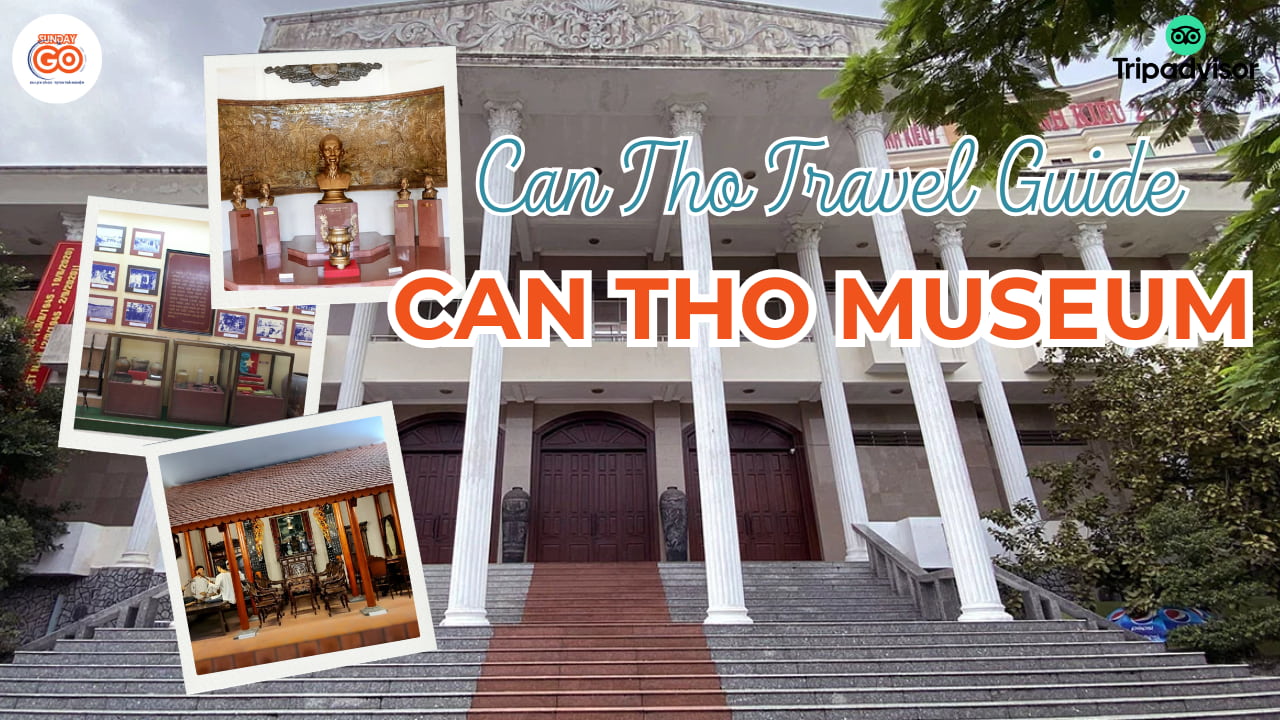
If you are planning a trip to the Mekong Delta, the Can Tho Museum is an unmissable stop. While the bustling Cai Rang Floating Market shows you the vibrant present of the region, this museum offers a quiet, fascinating deep dive into its past.
As a travel brand with over 5 years of experience serving international guests, Sunday Go knows that travelers often struggle to find accurate, up-to-date information about local heritage sites. Is it open on weekends? Is there an entrance fee? Is it worth your time?
We have compiled this complete guide to help you navigate the Can Tho Museum like a local expert.
Can Tho museum: Know Before You Go
Before we dive into the exhibits, here are the essential logistics you need for your itinerary.
- Address: No. 1, Hoa Binh Avenue, Tan An Ward, Ninh Kieu District, Can Tho City.
- Entrance Fee: Free (Guests generally do not pay for tickets)
- Suggested Duration: 45 minutes to 1.5 hours
- Best For: History buffs, culture seekers, families, and solo travelers
Can Tho Museum Opening Hours (2026)
One of the most common questions we get is about the schedule. Unlike some tourist spots that stay open all day, the museum follows a traditional administrative schedule with a lunch break.
Standard Schedule:
- Morning: 8:00 AM – 11:00 AM
- Afternoon: 2:00 PM – 5:00 PM
- Days Open: Tuesdays, Wednesdays, and Thursdays.
Weekend & Holiday Schedule:
On Saturdays, Sundays, and public holidays, the museum often extends its hours to serve more visitors, including an evening slot:
- Morning & Afternoon: Same as weekdays.
- Evening: 6:30 PM – 9:00 PM (Subject to change based on specific events).
Can Tho Museum Tickets: Is it Really Free?
Yes. Currently, Can Tho Museum tickets are free for both domestic and international visitors.
While many museums in Vietnam charge a small fee (usually 20,000–40,000 VND), this site is fully subsidized by the local government to promote the cultural heritage of the Mekong Delta. You can walk right in without queuing for a ticket.
Note: If you require a professional guide or a narrator for a large group, you should contact the administration in advance, which may incur a service fee.
What to See: A Journey Through Mekong History
The museum is a large, well-organized building with over 2,700 square meters of exhibition space. It holds thousands of artifacts, documents, and displays. Here is what you should focus on to ensure semantic completeness in your understanding of the region.
The Three Cultures (Kinh, Hoa, Khmer)
This is the heart of the museum’s cultural value. The Mekong Delta is a melting pot of three major ethnic groups.
- The Khmer: Look for traditional musical instruments, Theravada Buddhist statues, and vibrant festival costumes.
- The Hoa (Chinese origin): Detailed displays of traditional pharmacies, household altars, and intricate wood carvings.
- The Kinh (Vietnamese): Agricultural tools, fishing gear, and artifacts depicting the pioneer life of early settlers in the river region.
The Oc Eo Culture
For archaeology enthusiasts, the museum houses rare artifacts from the Oc Eo culture, an ancient civilization that flourished in the delta centuries ago. You can see pottery, jewelry, and tools that prove this region was a busy international trade hub long before modern times.
Resistance History of Country in The National Liberation Era
The second floor is largely dedicated to the history of resistance against foreign invaders.
- Exhibits: Weapons, photographs of local heroes, dioramas of guerrilla warfare, and personal items from soldiers.
- Context: This section offers a somber and important perspective on how the people of Can Tho fought for independence.
Can Tho Museum Photos: Best Spots & Etiquette
Travelers often ask us about photography. The museum is visually striking, but it is important to be respectful.
- Exterior Architecture: The building itself is a massive, modern structure blending local aesthetics. The front entrance with the large “Bảo tàng thành phố Cần Thơ” sign is a popular check-in spot.
- Dioramas: The life-sized dioramas (scenes of traditional life, markets, and battles) are excellent for photos as they are well-lit and realistic.
- Rules: Flash photography is often discouraged to preserve old artifacts. Always look for signage or ask a guard if you are unsure. Selfie sticks should be used with caution to avoid hitting glass display cases.
Can Tho Museum Reviews: What Travelers Say
To give you a trustworthy perspective, here is a summary of common feedback from international visitors.
The Good
- “Hidden Gem”: Many tourists are surprised by the depth of the collection given that it is free.
- “Cool Escape”: The museum is spacious and offers a cool break from the hot sun of the Mekong Delta.
- “Great Location”: It is right in the city center, making it easy to combine with other stops.
The Challenges
- Language Barrier: While many major signs have English translations, some detailed descriptions for specific artifacts may only be in Vietnamese.
- Old School Vibes: It is a traditional museum. Do not expect high-tech interactive screens or digital guides. It relies on physical artifacts and text.
How to Get There & Nearby Attractions
The museum is located in Ninh Kieu District, the tourism hub of Can Tho.
- From Ninh Kieu Wharf: It is just a 10-15 minute walk or a very short taxi ride.
- Map Search: You can type “Can Tho Museum” or “1 Hoa Binh Avenue” into Google Maps.
Create a Perfect Half-Day Itinerary:
Since a visit takes about 1 hour, Sunday Go recommends combining it with these nearby locations:
- Ninh Kieu Wharf: Visit the museum in the late afternoon (3:00 PM), then walk to the wharf for sunset.
- Can Tho Grand Prison: Located nearby, offering further historical context.
- Ong Temple: A stunning Chinese temple that pairs well with the “Hoa culture” exhibits you just saw at the museum.
Frequently Asked Questions (FAQs)
Is Can Tho Museum wheelchair accessible?
The museum has wide spaces and elevators, making it generally accessible, though some specific older sections might be harder to navigate.
Can I buy souvenirs at the museum?
There is a small area for souvenirs, but for a wider variety of local handicrafts, we recommend visiting the night market near Ninh Kieu Park.
Do I need to book in advance?
No, for individual travelers and small families, you can simply walk in during opening hours. No booking is required.
Conclusion
The Can Tho Museum is more than just a building full of old objects; it is the memory bank of the Mekong Delta. It tells the story of how the land was cultivated, how cultures merged, and how the city defended itself.
For travelers aged 22 to 60 who appreciate understanding the soul of a destination, this is a must-visit. It provides the context that makes your subsequent visits to floating markets and fruit orchards much more meaningful.
